by Ashley Oxford | Return on Investment
Comparing and Contrasting the Coaching Behaviors and Terminology Used by an Instructor to Teach Beginner, Intermediate, and Advanced Boys’ Basketball Players
Written by Lilly Schweickhardt, Academic Magnet High School, December 12, 2014
Abstract
This thesis explores the terminology and coaching behaviors used in practice by an instructor of beginner, intermediate, and advanced basketball players. Each session was categorized into nine groups: instructions, “Let’s go,” modeling positive, modeling negative, encouragement, scolds, smiles, and grunts. The modeling positive and negative categories were used when the coach demonstrated the correct or wrong way to perform a drill. It was hypothesized that the beginners would receive more encouragement than the advanced or intermediate athletes. To obtain the data, nine basketball practices were observed throughout the summer. It was found that the beginners received the most instructions, “Let’s go,” and encouragement, while the intermediate group was given the most modeling negative, and the advanced athletes obtained the most modeling positive, smiles, and grunts. The coach never scolded the athletes. The results of this thesis will help new basketball coaches who are unaware of coaching techniques. These coaches will understand that athletes of every skill level need encouragement as well as instructions and demonstrations to help them understand the drills.
(more…)
by Ashley Oxford | Return on Investment
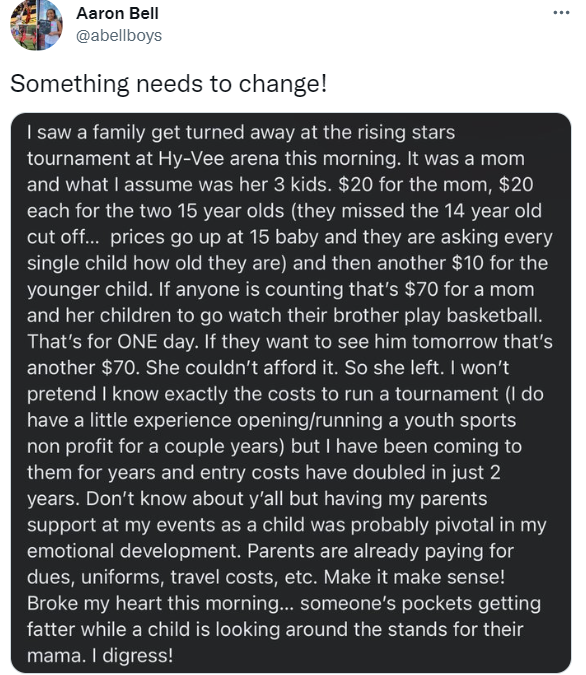
A recent viral tweet exposed the heavy costs associated with travel basketball and the burden it places on families.

Does this mean travel basketball should be avoided? NO. It means families need to take a long hard look at the RETURN ON INVESTMENT (ROI) for different programs.
(more…)

by Ashley Oxford | Mental Health
Trigger warning: This blog post discusses mental health and suicide. If you or someone you know may be struggling with suicidal thoughts, call the National Suicide Prevention Lifeline at 1-800-273-8255.
Since 1949, the United States has observed Mental Health Awareness Month during the month of May. The purpose of Mental Health Awareness Month is to take away the stigma that surrounds mental health.
We want to raise awareness for the mental health struggles that student-athletes specifically endure. Trying to make good grades while having practice or games almost every night, holding down a job during any extra time to help support the family, and feeling the pressure, not just from your family and coaches, but from your team and the entire community to win, can create mental health problems for even the most relaxed of individuals.
Due to societal pressures, even professional athletes have long suppressed the urge to speak out about their mental health. Thankfully, we are now seeing star athletes like Simone Biles, Michael Phelps and Naomi Osaka speak openly about their mental health and even forego competitions or games in order to prioritize their own health.
(more…)

by Ashley Oxford | 3RIPLE 3HREAT
In basketball, when you’re in the pivot position, you’re in the 3RIPLE 3HREAT position. You can either pass, dribble or shoot.
Often in basketball you can’t move both your feet. You have to work off of your pivot foot. You have to be grounded. If you move the pivot foot, you’ve walked which is against the rules. You have rivals in your face, the ball in your hands and you can’t move. What do you do? You pivot.
When you feel like you’ve hit a dead end or you can’t take your student-athlete career any further, just remember you’re in the pivot position… And that’s the 3RIPLE 3HREAT position. You aren’t cornered. It’s not a dead end.
(more…)

by Ashley Oxford | 3RIPLE 3HREAT, Mental Health
Athletes have long dealt with mental health issues along with physical health injuries. However, due to societal pressures, athletes have been conditioned not to speak out about these mental troubles.
We hear phrases like “be a team player’, “push through the pain” and “blood, sweat and tears.” Coaches and parents are trying to motivate athletes, but sometimes the athlete only hears the pressure and desire to win at all costs.
Recently professional athletes have taken a stand regarding their mental health. Olympic gymnast, Simone Biles, withdrew from the All-Around Finals during the Tokyo Olympic Games because of a mental health issue. Tennis star, Naomi Osaka, withdrew from the French Open to tend to her mental health.
These athletes and many more are challenging the idea that they have to be perfect in mind and body at all times. Naomi has said she faced “long bouts of depression” since winning the United States Open in 2018. Simone has been open about the pressure she feels from the entire country when she competes.
(more…)